
Brazilian cooperatives showcased cooperative responses to climate change at the 2025 United Nations Climate Change Conference (COP30) in Belém last month - and were mentioned in the event’s final declaration.
Signed by 44 countries and the EU, the Belém Declaration on Hunger, Poverty, and Human-Centered Climate Action confirmed it would “work to scale-up the share of climate finance from all sources to reach directly smallholder farmers, small scale agri-food enterprises, cooperatives, fisherfolk, workers associations, and other small-scale producers involved in primary production and domestic food and bio-based product processing and trade.
During the event, the cooperative movement had its own Coop Pavilion in the Green Zone of the COP30 venue, where it hosted sessions on the role of cooperatives in driving the energy transition and promoting people-centred climate solutions.
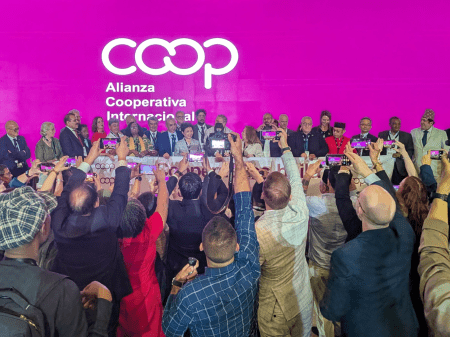
The Coop Pavilion opened on 14 November with a ceremony celebrating the closure of the UN International Year of Cooperatives. In attendance were the president of the OCB System, Márcio Lopes de Freitas; the president of the International Cooperative Alliance (ICA), Ariel Guarco; the President of the ICA Americas, José Alves de Souza Neto; the President of Frencoop, Congressman Arnaldo Jardim; and the special envoy for Agriculture at COP30, former President of the ICA and former Minister of Agriculture, Roberto Rodrigues.
“When the UN declares the International Year of Cooperatives, it gives visibility to something we experience every day in the territory: cooperatives mean local development, opportunity, and people prospering together. This is a model that delivers results for the country and the world, with environmental responsibility and social commitment,” said Mr Márcio.
Mr Guarco said cooperatives are as part of the solution for the ecological transition, for reducing inequalities, for generating decent work.
“This symbolic year represents a historic opportunity to affirm that the movement is prepared to lead structural changes. We are a model that works in practice,” he added.
Mr Alves highlighted the important contributions cooperatives make to the Americas.
“The Americas demonstrate the vitality of the cooperative model in different sectors: from agriculture to credit, from health to energy. In many territories, the cooperative is the main, and sometimes only, structure capable of generating income, organising production, and offering essential services to the population. This shows how strategic we are for sustainable development.”
Mr Rodrigues pointed out that the day was an opportunity to celebrate the very principle of cooperation.“If we want a more just, balanced, and sustainable world, the path lies in cooperation,” he added. “Cooperativism is not just a way of organising the economy – it is a set of values that responds to the greatest demands of humanity.”
The ceremony also featured video messages from Andrew Allimadi, UN Representative for Cooperatives, and Sheeren Zorba, Executive Secretary of the UN Science-Policy-Business Forum for the Environment (UN-SPBF) and Head of the Science, Policy and Business Interface at the United Nations Environment Programme (UNEP). Mr Allimadi said cooperatives demonstrate that it is possible to grow without leaving anyone behind, pointing out that the International Year of Cooperatives directly aligns with the 2030 Agenda and the Sustainable Development Goals (SDGs). Ms Zorba called for strengthening collective organisations to address the impacts of climate change on food production.
In his speech at the event, Congressman Arnaldo Jardim highlighted the growing alignment between the cooperative movement and the legislative agenda in Brazil. This was later reinforced by the adoption at the event of four Technical Cooperation Agreements (ACTs) between cooperatives and Natura and cooperatives and the Ministries of Agrarian Development and Family Agriculture (MDA), Entrepreneurship, Microenterprise and Small Business (Memp), and Development, Industry, Commerce and Services (MDIC).
“We believe in and experience daily the importance of being united in a cooperative ecosystem, of which government, companies, regulators, and cooperatives are a part. These agreements prove that cooperativism is part of the solutions that Brazil offers to the world,” said Mr Lopes de Freitas.