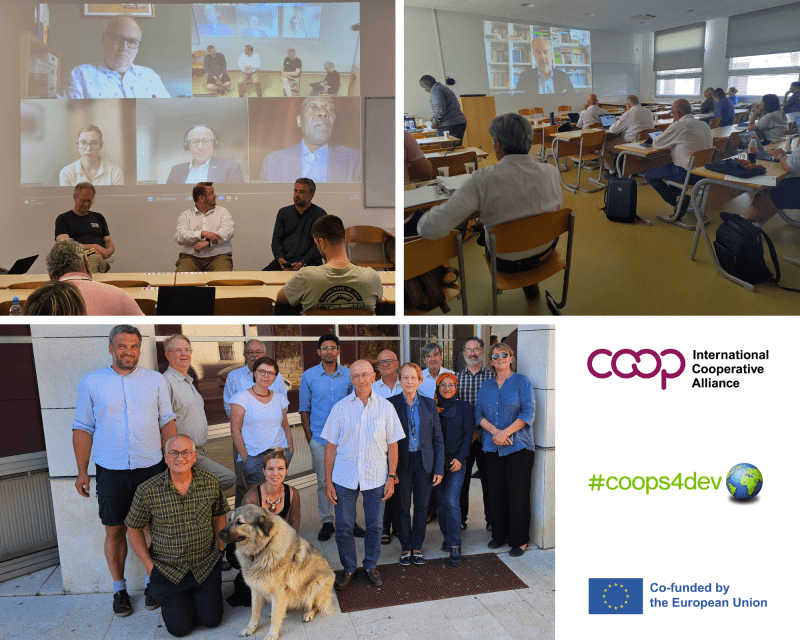
The International Cooperative Alliance (ICA), through its Financial Framework Partnership Agreement with the European Union (#coops4dev🌍), convened a successful two-day Workshop on Cooperative Law and Public Policy in Pula, Croatia, on 22–23 August 2026, on the heels of the Meeting of the ICA Cooperative Identity Advisory Group, and ahead of the ICA-Saint Mary’s University Cooperative Law Summer School, now in its third edition in its modern avatar.
The workshop brought together cooperative lawyers, researchers, practitioners and movement leaders to examine how the Cooperative Identity is translated into law, policy and institutional practice. The workshop combined expert interventions, sectoral perspectives and intensive small-group discussions focused on contemporary challenges surrounding the implementation of the cooperative principles.
A central objective of the workshop was to begin identifying the themes, concepts and legal questions that should form part of a future international commentary on cooperative law. Such a commentary would build from the ICA’s ongoing comparative Legal Framework Analysis (LFA) of national cooperative legislation, while using the ICA Guidance Notes on the Cooperative Principles (2015) as an important normative and analytical point of departure. In particular, the workshop returned to the “matters for future consideration” identified in the Guidance Notes and asked how these questions should now be understood in light of developments in legislation, cooperative practice and public policy across different jurisdictions.
The first day began with perspectives from the ICA Regions on the Legal Framework Analysis, followed by Blase Lambert, representing Cooperative Housing International on the ICA Board, who reflected on the international legal research on cooperative housing. A panel moderated by Alexandra Wilson examined cooperative identity in the housing sector, with contributions from Goran Jeras, Isaac Nyamongo, Ian Adderley, Andreea Nacu, Thomas Beckett and Mathias Fiedler.
The workshop then turned explicitly towards the possible principles of international cooperative law. Dante Cracogna, Hagen Henry, Jean-Louis Bancel, Cynthia Giagnocavo, Ifigeneia Douvitsa and Santosh Kumar contributed reflections drawing on experiences including the Principles of European Cooperative Law, and international cooperative principles. Preceding this, staff members from ICA Regional offices present the status of the implementation of the LFA in their regions. Annalisa Vallone and Paola Rosatelli (Cooperatives Europe), Melvin Khabenje (ICA Africa), Paula Arzadun (Cooperativas de las Americas) and Naveen Singh (ICA Asia and Pacific) were among the speakers.
On the second day, Giuseppe Guerini, ICA Vice-President and President of Cooperatives Europe, opened the substantive discussions with reflections on leadership and its place within the Cooperative Identity. Joseph Njuguna of the ICA presented the status and future strategy of the cooperative movement on achieving the SDGs.
An important international dimension was added by UNIDROIT, which presented its ongoing work and the draft UNIDROIT/FAO/IFAD Legal Guide on Collaborative Legal Structures for Agricultural Enterprises. The Guide is particularly relevant to the emerging comparative work because it examines cooperatives alongside companies and multiparty contractual structures, addressing matters including formation, governance, decision-making, liability, exit and dissolution. The exchange also demonstrated the importance of connecting the ICA's future commentary with relevant work undertaken by international organisations rather than examining national cooperative legislation in isolation.
Participants then worked in one group on three clusters of questions: sustainable development and Principle 7; cooperative acts, member economic participation, autonomy and independence under Principles 3 and 4; and openness, voluntarism, education, training and information under Principles 1 and 5.
The workshop’s main reflections were subsequently drawn together by Cynthia Giagnocavo, and Ifigeneia Douvitsa, followed by a special presentation by Nimmi Langer on “Happiness and Cooperative Law” and concluding remarks from Jean-Louis Bancel and Hagen Henry, the co-conveners of the workshop.
The Pula discussions demonstrated the value of moving beyond a purely descriptive comparison of cooperative statutes. The longer-term task is to understand, comparatively, how the cooperative principles acquire legal meaning, where national approaches converge or diverge, and whether recurring legal concepts can ultimately be articulated as principles of international cooperative law. The workshop therefore provided an important foundation for a broader international commentary by the ICA, capable of connecting cooperative identity, comparative legal analysis and the lived practice of cooperatives across jurisdictions.