
According to Humanitarian Action (part of the UN Office for the Coordination of Humanitarian Affairs (OCHA)), at the start of 2026 over 239 million people were in urgent need of humanitarian assistance and protection amidst entrenched conflicts that are greater in number, more violent against civilians and lasting longer than at any time since the Second World War. “Conflict is the main cause of death, displacement and hunger,” it says.
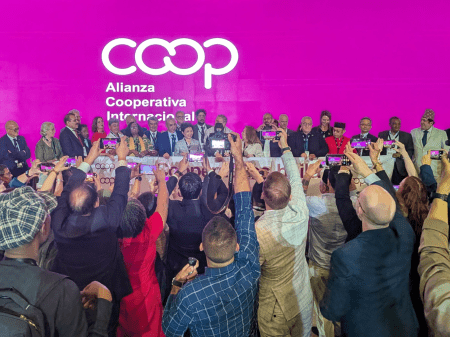
Cooperatives have long been acknowledged as the antithesis of conflict, and it is no coincidence that the themes of CoopsDay2026 and this year’s International Cooperative Alliance and Cooperatives of the Americas Global Conference in Panama both centre around Peace.
Ahead of both events, the ICA and COPAC have published the latest in their ongoing International Year of Cooperative Policy Briefs, which this month focuses on Sustainable Development Goal 16, which aims to promote peaceful and inclusive societies for sustainable development, provide access to justice for all and build effective, accountable and inclusive institutions at all levels.
The 2025 Global Progress Report on SDG 16 offers a sobering but important picture of where the world stands on peace, justice, and inclusion. Its central message is that while progress exists, it is uneven, fragile, and far too slow to meet the 2030 Agenda.
“This moment calls for a deeper understanding of what ‘peace’ truly entails,” says the policy brief.
“As articulated by peace scholar Johan Galtung, peace is not simply the absence of violence, what he terms ‘negative peace’, but also the presence of justice, inclusion, cooperation, and equality, or ‘positive peace.’”
These, the document adds, are the social, economic, and institutional foundations that sustain long-term stability. The brief includes several examples from around the world, from Rwanda, where cooperatives have served as platforms for reconciliation, accountable governance, and protection of rights, to Ukraine, where the Molochna Rika cooperative has overcome numerous challenges – from fluctuating markets to the disruption of war.
The cooperative model has long been associated with peaceful development, being grounded in the values of self-help, democracy, equality, equity, and solidarity, and promoting the idea that progress can be achieved through collective and peaceful action.
This peacebuilding role has been progressively articulated within the global movement, from the 1984 ICA Congress in Hamburg to subsequent reflections on cooperative values in Stockholm (1988) and Tokyo (1992), culminating in the 2019 ICA Kigali Declaration on Positive Peace which recognises cooperatives as contributors not only to the absence of conflict, but to the presence of justice, inclusion, and trust, the core foundations of peaceful and resilient societies.
By strengthening solidarity, widening participation, and addressing structural inequalities, cooperatives contribute in tangible ways to reducing the drivers of violence, expanding access to justice, promoting transparency and integrity, reinforcing accountable and effective institutions, and enabling more inclusive and representative decision-making. In doing so, they help translate the ambition of SDG 16 into lived realities, advancing more peaceful, just, and inclusive societies.
This publication has been produced under the ICA-EU Partnership (2024–2028), also known as #coops4dev🌍, a five-year international cooperative development programme co-funded by the European Union, aimed at strengthening the ICA network and positioning cooperatives as key actors in international development.
Download the policy briefs (in English, Spanish and French) below.