
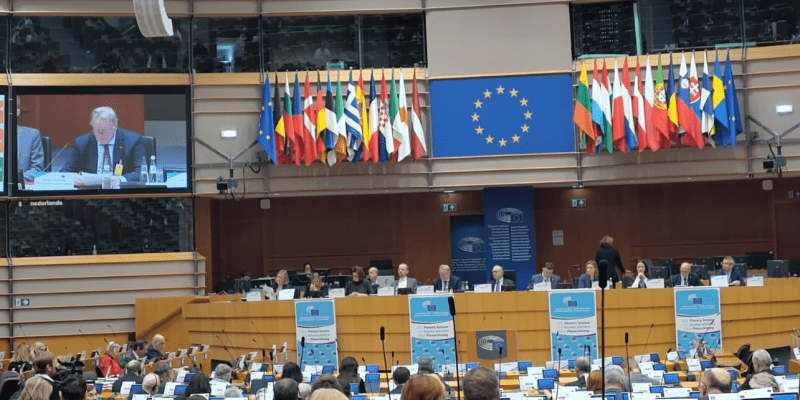
Giuseppe Guerini et Jeroen Douglas mettent en avant un plan de coopération pour une économie résiliente au Parlement européen
Lors de l’événement du Comité économique et social européen (CESE) intitulé « Les coopératives construisent un monde meilleur : la contribution du CESE à l’Année internationale des coopératives » Jeroen Douglas, Directeur général de l’Alliance coopérative internationale (ACI), a lancé un appel en faveur d’une transformation systémique de l’économie.
Son intervention, inscrite dans le cadre de l'adoption par le CESE de l'avis CCMI/242 sur les coopératives industrielles — dont Giuseppe Guerini, Président de Cooperatives Europe, est le corapporteur — a présenté les coopératives non pas comme un modèle complémentaire mais comme un élément fondamental d'une économie résiliente et préparée pour l’avenir.
M. Douglas a commencé par souligner l'urgence d’un changement de système économique, insistant sur le fait que la situation actuelle — marquée par l'instabilité climatique, la fragmentation géopolitique et l’aggravation des inégalités — exige bien plus qu’une réforme progressive. Les coopératives offrent précisément le type d'alternative structurelle nécessaire, a-t-il affirmé : elles sont démocratiques, ancrées dans la communauté et capables de créer de la valeur sur le long terme. Il a décrit les coopératives comme un « plan d’action » et a présenté le cadre stratégique de l’ACI, articulé autour de 15 axes d’action pour une économie mondiale fondée sur la durabilité et l’inclusion.
Un thème central de son intervention a été la capacité du mouvement coopératif à répondre aux crises mondiales interconnectées, en particulier dans les domaines du climat, de l'énergie et des systèmes alimentaires. M. Douglas a souligné l'importance croissante des solutions énergétiques démocratiques et des modèles de production renouvelable détenus par les communautés, des acteurs capables non seulement d'accélérer la transition écologique, mais aussi de garantir que les bénéfices restent ancrés localement. Il a également insisté sur la pertinence grandissante des coopératives de santé et d'aide sociale, rappelant leur capacité éprouvée à préserver l'accès, la qualité et l’accessibilité financière des soins dans des systèmes de santé de plus en plus sous tension. L'inclusion financière a occupé une place importante dans le discours de M. Douglas. Il a noté que les banques coopératives et les coopératives de crédit demeurent essentielles pour élargir l'accès au financement, en particulier pour les populations mal desservies et les PME. Il a surtout affirmé que les coopératives ne recherchent pas de subventions mais demandent plutôt des conditions de concurrence équitables, en reconnaissance de leurs structures de gouvernance uniques et de leur contribution au bien commun.
Il a plaidé pour une reconnaissance politique plus forte au niveau de l'Union européenne, exhortant les législateurs à prendre en compte la nature spécifique des coopératives dans le droit des sociétés et dans les cadres réglementaires. L'accès au financement constituait une autre priorité essentielle : il a encouragé l'Union européenne à veiller à ce que les coopératives puissent pleinement bénéficier des instruments liés à la transition écologique et juste, et des autres mécanismes de financement pertinents.
Élargissant le débat au-delà de l'Europe, M. Douglas a attiré l’attention sur le rôle que les coopératives peuvent jouer dans les pays en développement. Il a identifié le programme Global Gateway de l'Union européenne comme une opportunité stratégique pour mobiliser les coopératives dans la construction d'économies locales résilientes, notamment dans les régions où la démocratie économique est encore émergente. Pour ce faire, il a plaidé en faveur d'un dialogue structuré et permanent entre les institutions de l'Union européenne et Cooperatives Europe qu'il a qualifiée de « partenaire fiable » pour concevoir et mettre en œuvre des politiques intégrant pleinement les coopératives.
Son intervention a finalement rappelé que les coopératives ne sont pas des acteurs périphériques mais des composantes essentielles d'une architecture économique durable. Son message a trouvé un large écho dans le cadre plus large de l'événement : la compétitivité et la responsabilité sociale ne sont pas des objectifs opposés mais des piliers qui se renforcent mutuellement et les coopératives sont particulièrement bien placées pour les conjuguer.
Au nom de l’Alliance coopérative internationale, Jeroen Douglas a formulé trois appels à l’action.
1. Reconnaissance politique : exhorter l’Union européenne à reconnaître pleinement le caractère unique du modèle d’entreprise coopérative dans son droit des sociétés et dans ses cadres réglementaires. L’Union européenne doit dépasser la simple vision des coopératives comme de simples PME et reconnaître leur capacité à agir comme des acteurs économiques de grande envergure dotés d’une gouvernance démocratique.
2. Accès aux financements : garantir que les coopératives — en particulier celles engagées dans une transition écologique et juste — disposent d’un accès équitable et direct aux mécanismes de financement pertinents de l’Union européenne. Elles constituent des vecteurs idéaux pour assurer que les investissements européens aient un impact maximal au niveau local. Assurer également un accès équitable aux financements du Global Gateway avec la création d’un fonds dédié pour investir dans les coopératives des pays en développement.
3. Partenariat stratégique : approfondir le dialogue structurel entre l’ACI et son bureau régional, Cooperatives Europe, ainsi que les secteurs de l’ACI, avec l’Organisation internationale du Travail et les institutions de l’Union européenne.
Il a conclu en affirmant que l’ACI était prête à être le partenaire le plus fiable pour concrétiser les ambitions du Pacte vert, du Socle européen des droits sociaux et d’une économie européenne résiliente et compétitive.
Parmi les autres intervenants figuraient des représentants de l'OIT, de l'OCDE et de la DG GROW.
Dans son intervention, Mme Carlien van Empel, Directrice du Bureau de l'OIT pour l'Union européenne et le Benelux, a souligné que l'avis CCMI/242 du CESE reflète fidèlement l'essence des coopératives industrielles et leur rôle dans l'économie actuelle. Elle a insisté sur le fait que les coopératives contribuent bien au-delà de la simple production de biens et de services : elles construisent des chaînes d'approvisionnement inclusives, offrent des emplois de qualité et renforcent à la fois la résilience et la gouvernance démocratique. Mme van Empel a souligné que les coopératives ne doivent pas être perçues comme un modèle « alternatif » mais comme une approche économique à part entière, fondée sur le mutualisme, la solidarité et la coopération. Dans les secteurs de la production manufacturière, la production numérique et les industries de transformation, les coopératives font preuve d'une remarquable capacité à maintenir l'emploi et la stabilité même en période de difficultés économiques. Inscrites dans l'économie sociale et solidaire, elles veillent à ce que la valeur créée soit réinvestie localement, renforçant ainsi les communautés. Elle a soutenu que les coopératives industrielles sont essentielles à une compétitivité inclusive et durable, un domaine dans lequel l'Europe peut jouer un rôle moteur grâce à ses fortes traditions de développement économique fondé sur les droits et une juste répartition de la valeur. Mme Van Empel a réaffirmé le partenariat stratégique de l’OIT avec l’ACI et a rappelé les principales normes internationales du travail, notamment la Recommandation 193 qui appelle à la création d’environnements favorables, au renforcement des capacités et à l’accès au financement.
Dans son intervention, le Dr Joachim Schwerin, économiste principal de l'unité « Conduite responsable des entreprises » au sein de la Direction générale du marché intérieur, de l'industrie, de l'entrepreneuriat et des PME (DG GROW) de la Commission européenne, a souligné que le débat sur les coopératives dépasse largement le cadre de l'Année internationale des coopératives, notant que l'avis du CESE offre une excellente analyse prospective. Il a insisté sur le fait que les principes coopératifs s'enracinent dans ce qu'il a appelé « l'ADN de l'humanité », des valeurs qui ont façonné les sociétés tout au long de l'Histoire. Pour M. Schwerin, l'importance des coopératives réside non seulement dans ce qu’elles accomplissent mais aussi dans leur mode de fonctionnement : par la participation démocratique, la gouvernance participative et la prise de décision inclusive.
Ces pratiques, a-t-il affirmé, donnent l’exemple de la démocratie en action qui ne peut être atteinte par de simples instructions formelles mais doit se vivre à travers des comportements et des valeurs partagées. M. Schwerin a souligné la pertinence des coopératives dans les secteurs industriel et financier, rappelant leur longue tradition intellectuelle et pratique en Europe. Il a établi un lien entre la pensée coopérative et les défis contemporains, en particulier la numérisation de l'économie. Fait notable, il a relevé des parallèles intéressants entre les principes et les mécanismes coopératifs qui émergent sur le marché des cryptoactifs, tels que le transfert de valeur décentralisé et le vote sur blockchain, tout en mettant en garde contre les distorsions introduites par les grandes entreprises technologiques. L’éducation, a-t-il insisté, est essentielle au renforcement de la culture coopérative, appelant à des initiatives d’envergure impliquant les organisations sociales et les coopératives.
En conclusion, M. Schwerin a exhorté à un effort renouvelé pour renforcer l’image publique des coopératives et les promouvoir comme des modèles économiques durables et résilients pour l’avenir de l’Europe.
M. Séamus Boland, Président du CESE, a conclu le débat en affirmant que les coopératives démontrent que compétitivité et responsabilité sociale ne sont pas des objectifs contradictoires.
L’ACI a remercié M. Giuseppe Guerini d’avoir porté l’agenda coopératif au sein du CESE et le félicite pour l’adoption de l’avis CCMI/242 « Les coopératives industrielles : un outil pour relever le défi d’une compétitivité inclusive et durable »