
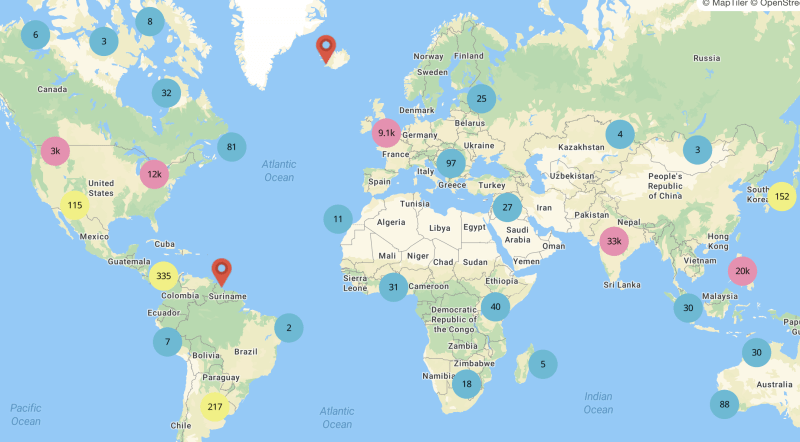
Data drives knowledge, awareness and decision making, and is a vital part of the global cooperative story. The annual World Cooperative Monitor (WCM) is one such project that collects data, listing the world’s top 300 cooperative businesses and sharing the staggering facts and figures that go alongside them.
Data is also one of the five core pillars of the ICA’s 2026-2030 strategy, Practice, Promote, Protect, and a key framework for action. “Data builds knowledge power,” it says. “We harness cooperative knowledge, research, and digital engagement to strengthen decision-making and advocacy. This includes developing data collection protocols, creating research databases, mapping cooperative initiatives globally, and launching innovative platforms like cooperative AI chatbots to make information accessible to all cooperatives.”
Long-term, the ICA wants to deliver data services to “to and between cooperatives and their communities worldwide to enhance their intelligence, business and financial acumen and effective cooperation among cooperatives.”
The WCM is supported by the International Cooperative Entrepreneurship Think Tank (ICETT), which acts as a key strategic partner, collaborating closely to determine, analyse, and highlight the figures behind the global cooperative movement.
But 2025 WCM – a special edition for the International Year of Cooperatives – “does not only contain numerical data, but it also testimonies of people involved in the day-to-day operations in different economic sectors,” says ICETT chair, Thomas Blondeel. “we wanted to show very explicitly the story behind the numbers.”
Many countries do collect data national data on cooperatives – including France, Australia, Portugal and Italy. Recently, the Belgian Cooperative Monitor published by KCO KU Leuven and Cera, gave an overview of the cooperative landscape in Belgium for the period 2016–2025. Co-operatives UK publishes an annual Co‑operative and Mutual Economy Report, and in January, the US Federation of Worker Cooperatives and the Democracy at Work Institute published a 2025 State of the Sector report looking at worker cooperatives and democratic workplaces. ICA Asia Pacific publishes regular Country Snapshots (like this one on Sri Lanka), and last year the University of Ghana Business School published a comprehensive State of Cooperatives Report.
Another point of data collection is the Cooperative World Map. Produced by DotCoop in partnership with the ICA and other national cooperative bodies, the map is an interactive and up-to-date digital map that aspires to unite and showcase all cooperative entities in the world.
“We now have over 62,000 cooperative enterprises on the map – but we know there are millions more, and we still need your help to find out who and where they are,” says DotCoop’s Tom Ivey. To get cooperatives on the map, membership bodies can securely share organisations’ names, addresses, websites and sectors (it can be as simple as a spreadsheet). To find out more, contact support@worldmap.coop.
“Last year we improved how we merge the different sources of data, reducing duplicate entries, and better unifying data for individual cooperatives in different data sets, and built new structure to our processes, making it easier for data partners to join, to refresh their data and fixed a range of bugs.”
Find out more about the World Cooperative Monitor at monitor.coop.
Find out more about the ICA’s Strategy here.
Find out more about the Cooperative World Map at worldmap.coop