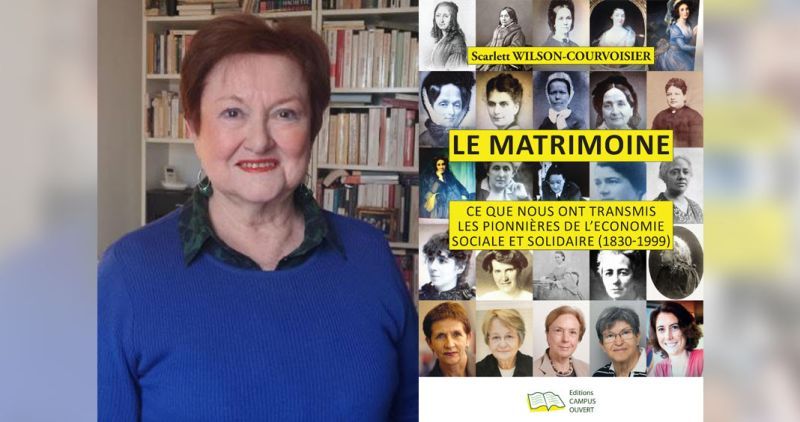
In 2025, Scarlett Wilson-Courvoisier published Matrimoine de l'ESS, highlighting the contributions of women to the social and solidarity economy from 1830-1999.
She tells the stories of overlooked women in associations, cooperatives, and mutual societies – and this year has also been urging those working in SSE to draw inspiration from these pioneering women in their gender equality work.
Wilson-Courvoisier worked at the Delegation for the Social and Solidarity Economy for 25 years, was a member of the FemmeESS Collective, and has been involved since its founding in the Gender Equality Commission of the High Council of the SSE. The project, she says, aims to pay tribute to women who shaped the history of the SSE — often working in the shadows — while also highlighting those who are major players in it today.
“Throughout their lives and struggles, [these women] displayed exceptional mental and moral strength, energy, and courage to face countless adversaries and adversities, ingrained assumptions and stereotypes, and an entire society rooted in patriarchy — still very much alive today — not to mention imprisonment, forced labour, revolutions, and wars,” she said in an interview with French cooperative federation, Coop FR, in March.
“They demonstrated both extraordinary boldness and selfless tenacity in supporting their various causes, imagining and creating initiatives and actions, new professions, and the first sectors of what would become the SSE – concretely advancing the cause and rights of all women in the long struggle towards gender equality.”
These women, she added, knew how to harness the power of collective action, and were able to spark, mobilise, and give rise to the founding movements of the SSE and their earliest structures.
Wilson-Courvoisier argues that democracy and gender equality cannot be conceived without one another, backing this up with the contextualised life stories of 99 French women from the 19th and 20th centuries who all, through their actions, writings, and struggles, contributed to the emergence of the social and solidarity economy.
These women include pioneering feminist and socialist activist Jeanne Deroin (1805–1894) and early cooperator Marie Moret (1840–1908), alongside more contemporary figures such as activist and business leader Laurence Ruffin (born 1978), who in March became the first ever woman elected mayor of Grenoble, at the head of a left-wing and ecological coalition.
The book notes the history of consumer and financial cooperatives, but for Wilson-Courvoisier it is the worker and participatory cooperatives (SCICs and CAEs) that, in her view, adopt more democratic rules with more proactive approaches to parity than others.
“That is why Le Matrimoine ends with women in SCOPs, having first interviewed several women working in rural, farming, and agricultural environments, which face heavy challenges and significant transformations,” she says. “What would be both useful and valuable is to identify internally, within each cooperative sector, all the experiences, methods, and approaches being tried in order to move towards — or better still, to achieve — genuine parity.”
The Matrimoine de l'ESS project was supported by Crédit Coopératif Foundation, the Maison de Salins, and the State Secretariat for Social, Solidarity and Responsible Economy, and the physical book is available to buy in French here.