Last year saw two major milestones for the global cooperative movement: the Second World Social Summit, held in Doha in November 2025, and the UN International Year of Cooperatives 2025 (IYC2025). On 6 February, the International Cooperative Alliance (ICA), together with the Committee for the Promotion and Advancement of Cooperatives (COPAC), hosted an event to explore how cooperatives and SSE actors can help the UN translate the Doha commitments and the IYC2025 legacy into concrete policies and programmes that advance social justice, reduce inequalities, and strengthen the social dimension of sustainable development.
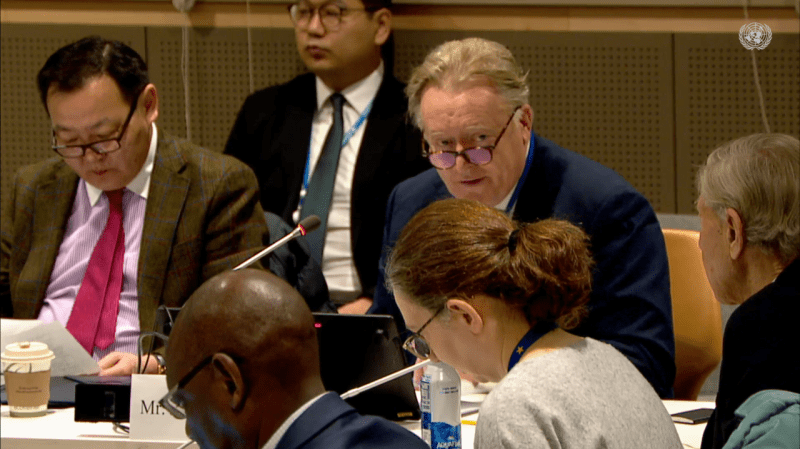
The event took place at the UN headquarters in New York, as part of the 64th session of the United Nations Commission for Social Development (CSocD64). Charles Katoanga, Director of UNDESA Division for Inclusive Social Development, said that member states have given the CSocD a “clear mandate” to guide the follow-up to the World Social Summit's outcomes, and to help shape a coherent global pathway for advancing social development and social justice.
Describing cooperatives and the social and solidarity economy as “essential engines of progress along that pathway”, he noted that the Doha political declaration identifies support to cooperatives and the SSE as an enabling factor in achieving inclusive and sustainable economic growth, full and productive employment and decent work for all.
International Cooperative Alliance Director-General, Jeroen Douglas, highlighted some of the achievements of the IYC2025, including the development of lasting initiatives across regional and local cooperative communities, building on improvements to co-op law, and the establishment of Cooperatives and Mutuals Leadership Circle (CM50).
Douglas and Katoanga both commended Mongolia’s leadership in advocating for the adoption of the UN International Year of Cooperatives in both 2012 and 2025.
H.E. Ambassador Ankhbayar Nyamdorj, the Permanent Representative of Mongolia to the UN, also spoke at the event, and noted that while the IYC2025 significantly enhanced global recognition of cooperatives as key development partners, the next step is to move from commitments to implementation.
“The continued advancement of cooperatives and the SSE requires sustained political commitment, coherent policy frameworks, and strengthened international cooperation,” Nyamdorj added. “By aligning national actions with global commitments, enhancing knowledge sharing and investment, and investing in people-centred institutions, we can ensure that cooperative and SSE models contribute meaningfully to social justice, economic resilience and sustainable development.” He also called on the observation of the 2026 UN International Year of Rangelands and Pastoralists.
A keynote address by Rashmi Banga, Chief, UNDESA’s Development Research Branch, underscored the urgency of the co-op movement’s mission. “Marginalised groups are being disproportionately impacted by climate change and shifting geopolitics”, she warned, “while existing inequalities are being compounded by a technological divide”. AI is a particular concern.
“AI is different from other technologies because of the speed at which it is advancing, and the scale at which it is spreading … [The] AI divide is producing compound social exclusions affecting education, income, health, voice, identity and dignity. It transforms inequality from material to capability-based, which is harder to correct unless addressed systematically.” There is a role here for democratically owned enterprises in responding to these challenges, she added, urging a paradigm shift “from the logic of profit to the logic of need, from competition to cooperation, and exploitation to emancipation”.
The role of cooperatives and the SSE in achieving social justice was explored further in a panel moderated by Doug O’Brien, President and CEO of NCBA Clusa.
“Cooperatives and the broader social and solidarity economy are receiving increased attention coming out of the World Social Summit, the Doha political declaration and the International Year of Cooperatives - there has been a real shift in how cooperatives are recognised,” he said.“That recognition matters. It signals that cooperatives aren't a side note to development policy; they are part of a core strategy.”
Agata Wozniak, a Counsellor from the EU Delegation to the UN, described the EU’s Social Economy Action Plan adopted in 2021, and the ongoing work needed to raise awareness and understanding of co-ops and the SSE amongst EU members. She also highlighted the strategic value of global networks such as the ICA, the importance of agri-food value chains to EU-supported co-ops, the positive impact of the SSE on women and young people, and how international partnerships are helping to influence policy and development strategies.
“We support cooperatives in advancing friendly legal frameworks, ensuring their systematic role is recognised by national law,” said Wozniak. “The goal is to move from project-level results to building a sustainable, systematic role for cooperatives in the global economy.”
Jun He, Policy Officer and Team Leader at the Food and Agriculture Organization (FAO), spoke about cooperatives’ role in supporting marginalised farming communities, in particular women and young people.
Last year, the FAO and the ICA facilitated a Youth Declaration on Cooperatives in Agrifood systems, at the World Food Forum in Italy, bringing together 32 young cooperators from six countries, highlighting gaps in access to land, finance, markets and governance, and the importance of engaging young people, especially young women.
2026 is the UN International Year of the Woman Farmer, which, said He, is an opportunity to consolidate efforts to support rural women cooperatives. “We must move from vision to action. We encourage member states, UN agencies, cooperatives and social and solidarity economic actors to align their policies, programs and partnerships around the leadership and the rise of women, farmers and their organisations.”
Fabiola Motta, Superintendent of the Organization of Brazilian Cooperatives (OCB), stressed the importance of supportive policy frameworks in creating conditions for co-ops to invest, innovate and expand services. In Brazil, OCB worked with policymakers between the 2012 and 2025 IYCs to develop 100 regulatory and policy advances. Motta called on UN member states to treat cooperatives “not as exceptions, but as strategic partners for economic development, social inclusion, democratic participation and sustainability”.
Simel Esim, Head of the International Labour Organization Cooperative and SSE Unit and Chair of the UN Inter-Agency Task Force on the SSE, praised strengthened support for co-ops in recent years, including UN General Assembly resolutions on co-ops and the SSE, but warned that, globally, “the unfolding trajectory raises serious concerns”.
“Inequality is widening, insecurity is deepening, and fiscal and institutional constraints are tightening, just as needs are arising, making implementation more urgent yet harder,” she said. As reflections begin on the post-2030 development agenda, cooperatives and social and solidarity economy entities should be given due consideration as practical pathways for poverty eradication, full and productive employment and decent work for all social integration and social justice.”
Howard Brodsky, Co-founder and Chair of CCA Global Partners, delivered a presentation on how the CM50 is taking action. “It is not just a convening platform. It’s a structural platform designed to turn influence into action”, said Brodsky, who is leading the CM50’s commitment to supporting cooperation among cooperatives via a digital platform, the Principle Six Cooperative, or P6.
As cooperators use P6, explains Brodsky, “cooperatives’ local knowledge of governance, inclusion, job creation, resilience and growth becomes a collective asset for the global movement, without compromising cooperative autonomy.”
He added: “The infrastructure to deliver is being built. The question is no longer whether cooperative solutions work - they do. The question is whether we are willing to invest collectively in a shared system that allows us to shape the future at the scale that this moment demands”.
This event was organized under the ICA-EU Partnership (2024-2028) -also called #coops4dev🌍-, a five-year international cooperative development program that aims to strengthen the ICA network and position cooperatives as international development actors in the EU Development Agenda.
The recording of the event can be found here: https://webtv.un.org/en/asset/k1u/k1ub09jriv.