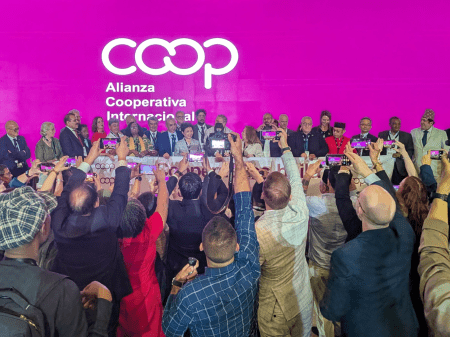
As part of the ICA Global Cooperative Conference in Panama in September, legal experts and other interested parties gathered for the IX Continental Congress on Cooperative Law and II International Symposium on Cooperative Law.
The Americas Region of the ICA has long played a distinctive role in the development of cooperative law, contributing not only legislation and scholarship but also early recognition that cooperative law requires sustained dialogue and comparative thinking across regions and legal traditions. Meanwhile, the first International Symposium was held at the Peace Palace in The Hague on United Nations Day, 24 October 2025, during the International Year of Cooperative, conceived as a regular meeting place for cooperative lawyers, scholars, practitioners and movement leaders to examine how law can preserve cooperative identity while responding to economic, technological and societal change.
In Panama, the events examined recent trends and developments in cooperative law alongside the ICA Global Conference, held under the theme “Building Bridges: Cooperative Solutions for a Peaceful World”, with Peace becoming a central topic.
“International law provides an important normative context for that inquiry,” said Santosh Kumar, ICA director of legislation and Coordinator of the International Symposium. “The international human rights architecture, including the International Covenant on Civil and Political Rights and the International Covenant on Economic, Social and Cultural Rights, is founded upon ideas of human dignity, participation, equality and social progress. In 2016, the United Nations General Assembly adopted the Declaration on the Right to Peace, placing further emphasis on the relationship between peace, human rights and development.”
For cooperative lawyers, he adds, this opened a particularly compelling question: can cooperatives and cooperators be actors of peace, and, if so, what role does law play in enabling them to fulfil that function?
Delegates explored this idea through examining how cooperative law structures relationships between people and affects the organisation of economic power. Some of the most pressing questions, Kumar adds, are around the ideas of cooperation among cooperatives, digitalisation, taxation, regional integration, member participation, legal innovation and the intergenerational transmission of the cooperative idea.
Opening the International Symposium, Giuseppe Guerini reflected on leadership and its relationship with the ICA Statement on the Cooperative Identity, raising the question of how leadership should be understood in institutions whose authority ultimately derives from democratic membership based on cooperative values and principles.
The Symposium also deliberately brought a younger generation of lawyers into the discussion. Dulce Bustamante examined whether legal innovation can facilitate the intergenerational transmission of the cooperative idea, bringing examples from the Philippines. Why should cooperative law matter to young people? What kind of participation can reasonably be expected when meetings, voting, information and even economic exchange increasingly take place digitally?
In sessions moderated by Nicolas Jaquet of the Regional Commission on Cooperative Law and Santosh Kumar, delegates shared experiences across other regions and legal traditions too. Osamu Nakano of the Japan Workers’ Co-operative Union brought perspectives from the Japanese worker cooperative experience, while Merav Niv of the Kibbutz Movement reflected on the evolution of one of the world's most distinctive traditions of collective organisation. Their interventions illustrated how cooperative institutions emerge from particular histories and societies, yet confront questions – of participation, continuity, adaptation and identity – that increasingly transcend national borders.
Professor Carlos Vargas and Professor Marina Aguilar Rubio contributed perspectives on innovation, integration and taxation in cooperative law. Their interventions underscored an important tension facing legislators everywhere: how can cooperative law facilitate innovation without progressively eroding the characteristics that justify recognition of the cooperative as a distinct legal form?
Technology emerged as another important frontier, with Dr Morshed Mannan of the University of Edinburgh spoke about the implications of technological change for membership, governance and participation, while the contributions from Moshi Co-operative University brought an African perspective, including reflections on regional approaches to cooperative legislation and the development of a model cooperative legal framework.
The relationship between cooperative law and peace came most directly into focus in a dialogue between Professor Dante Cracogna, Chair of the Regional Commission on Cooperative Law (who also served as President of the Congress and Symposium), and Professor Hagen Henry, Chair of the ICA Cooperative Law Committee. If cooperatives are institutions founded upon democratic participation, autonomy, solidarity, education, cooperation and concern for community, can these characteristics contribute to more peaceful economic and social relations?, they asked. And so, how should law protect the institutional conditions that allow cooperatives to perform that role?
The discussion, moderated by Kristin Murray of Newfoundland and Labrador, a recipient of the Ian MacPherson Legacy Fund, also recalled the intellectual legacy of Ian MacPherson and the development of the contemporary articulation of the Cooperative Identity. “It also raised the question of whether the cooperative way of organising economic relationships – through participation rather than domination, mutuality rather than extraction, and responsibility alongside rights – can itself contribute to the institutional foundations of peaceful societies,” said Kumar.
“And if it can, another question follows: what rights and responsibilities do cooperatives and cooperators carry in building and preserving those conditions?”
An important bridge between the regional and international discussions was the renewed ICA Legal Framework Analysis (LFA), supported through the ICA–EU partnership, with representatives of the ICA Regional Offices presenting updates on the status, vision and timelines of research into cooperative legal frameworks in their respective regions.
The event also saw the launch of amicus.coop, which seeks to bring cooperative law closer to those who make, interpret and use it – connecting legislation, jurisprudence, policy, comparative knowledge and a community of cooperative legal expertise within a shared digital space. “Amicus.coop represents another bridge,” says Kumar, “between scholarship and practice, between cooperative identity and its legal expression, and among a global community of cooperative lawyers increasingly able to remain connected beyond the conference room.”
María Eugenia Pérez Zea of Colombia, a returning member of the ICA Board representing Coomeva and President of the Colombian association of cooperative lawyers, delivered a valedictory address, providing a connection between the Americas’ long tradition of cooperative legal scholarship and the emerging international agenda, while Professor Dante Cracogna shared principal reflections and takeaways within the closing session of the wider ICA Global Conference
“The significance of Panama may ultimately lie in the connections we made, and the questions we raised" says Kumar, “including, what kind of law allows cooperation to flourish as an instrument of peace?”
“The answer will not be found in legislation alone. It will require comparative research, jurisprudence, institutional experimentation and sustained dialogue among lawmakers, scholars, practitioners and cooperators themselves. But that is precisely why these forums matter.”