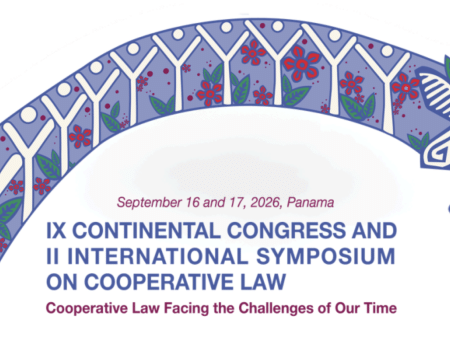
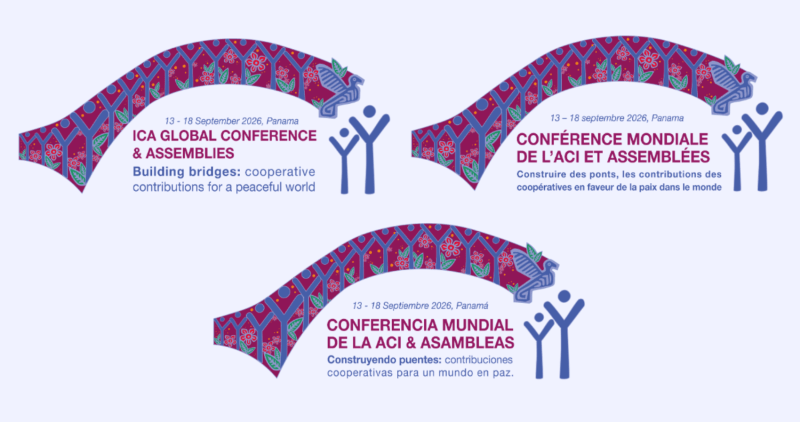
The visual identity for the 2026 ICA Global Conference has been revealed. The logo, which places the bridge of the Americas at the centre, is a visual representation of the cooperative movement as a living bridge between cultures, territories, and people. Each element of the logo contributes both aesthetic value and meanings deeply aligned with Panama's cultural identity.
The logo was designed by COOMUNICCAR Workers' Cooperative Ltd, founded in 2010 in Necochea, Province of Buenos Aires, Argentina, as an initiative by young communication professionals, technicians and university graduates. Since then, it has operated as a self-managed production company that combines creativity, technical expertise and collective commitment to offer comprehensive communication solutions.
“Our management model is based on collaborative planning, using the professional expertise of each member and collective working practices, supported by appropriate infrastructure and up-to-date technology,” said Natalia Mailland, Producer/Coordinator at COOMUNICCAR. “This allows it to guarantee quality, creative and tailored productions adapted to diverse client profiles.”
With more than 16 years of experience and nine members, COOMUNICCAR specialises in the production, creation and distribution of audiovisual, graphic, audio and multimedia content, as well as providing digital communication consultancy. It also incorporates web design, integrating aesthetics, functionality and strategy to strengthen the digital presence of organisations, businesses and projects – and delivers training in audiovisual trades, cooperativism and gender equity.
“COOMUNICCAR maintains a strong connection with the cooperative movement, holding the Vice-Presidency of the Federation of Workers' Cooperatives of the Argentine Republic (FECOOTRA) through its member Sofía Imeroni, and participating actively in ICA member apex Argentine organisation COOPERAR,” says Mailland.
“Along this journey, we reaffirm our commitment to gender equity, participating actively in the FECOOTRA and COOPERAR committees and in cooperative spaces that drive collective transformation. With every project, the cooperative upholds its commitment to quality communication, equity and the building of a fairer and more inclusive world.”
Mailland explains that the cooperative responded to the ICA design tender “because we believe that visual identity is a key tool for strengthening cooperativism at a global level. Furthermore, taking part in this process represents for our cooperative an opportunity for dignified work and professional growth. We hope to bring creativity and collective commitment, drawing on our experience, to such an important event.”
To her, the visual identity created for #ICAPanama2026 “brings together territory, culture, people and values, showing that the true bridge is made up of organised communities and that cooperation is the path towards peace and social transformation.”
The Bridge of the Americas in Panama City, forms the structural axis of the design, as a representation of the iconic geographical and symbolic landmark of Panama, which links North and South America, and functions as a direct metaphor for international cooperation.
Stylised human figures are integrated into its structure, reinforcing the idea that cooperativism is not an abstraction, but a concrete network of people who sustain, connect, and give meaning to the system.
The mola pattern introduces a key cultural dimension. Molas, native to Panama's indigenous peoples, bring identity, rootedness, and recognition of diversity. Their inclusion represents the integration of knowledge, traditions, and worldviews within the global cooperative movement.
Orange dots run through the structure like a network of energy and connection. They represent the nodes of global cooperativism: small actions, communities, and experiences that, when linked together, bring life, dynamism, and continuity to the bridge.
The leaves and flowers that emerge within the composition reinforce the idea of growth, life, and sustainability, while also establishing a direct connection to Panama's natural richness and biodiversity.
The dove at the end of the bridge is the universal symbol of peace, closing this virtuous circle of cooperation and emphasising the collective call from the global cooperative movement to actively contribute to peace.
The human figures at the end show this is not a closed structure, but a process in motion: the bridge reaches others, invites encounter, and proposes continuity. It represents openness, dialogue, and constant collective construction.
Taken together, the visual identity encapsulates the ultimate goal of the gathering: to build a more just and peaceful world through cooperation. Because “building bridges” is very much what cooperatives do every day through democratic participation – building habits, skills, and expectations that go far beyond the enterprise itself.